
The complete guide
Cat Safety Nets for Balconies and Windows, A Practical Buyer's Guide
The problem with balconies and cats
A cat chasing a bird or startled by a noise does not think about the drop. So many balcony doors stay shut.
A cat safety net gives you another option. The space stays usable, the cat gets fresh air and a sunny spot, and there is a mesh barrier across the opening. It only works as well as it is fitted and checked.
This guide covers what to look for, how this particular net works, and how to fit it so it actually does its job.
How a cat net works
The idea is simple. You stretch a mesh panel across the open side of a balcony, window or terrace and anchor it firmly along every edge. The cat can see through it and feel the breeze through it.
Two things matter most: the net itself and how well it is fixed.
The net described here has wire woven through the polyethylene strands. The product record does not give a chew, tear or load rating, so check it often.
On fixing, many failures are installation problems. A net tied at four corners only is weaker than one tied every 30 centimetres. Tension is what makes the panel behave like a wall instead of a curtain.
What you get with this net
The panel is 8 metres long and 3 metres wide, in black. Balconies vary, and it is far easier to fold or trim surplus than to join two short pieces together without leaving a weak seam.
The mesh openings are 3cm by 3cm. Smaller mesh gives a visible grey haze across your view and more wind load.
A cat net black finish is less visible against railings and shadow than pale netting.
Packed weight is 2kg.
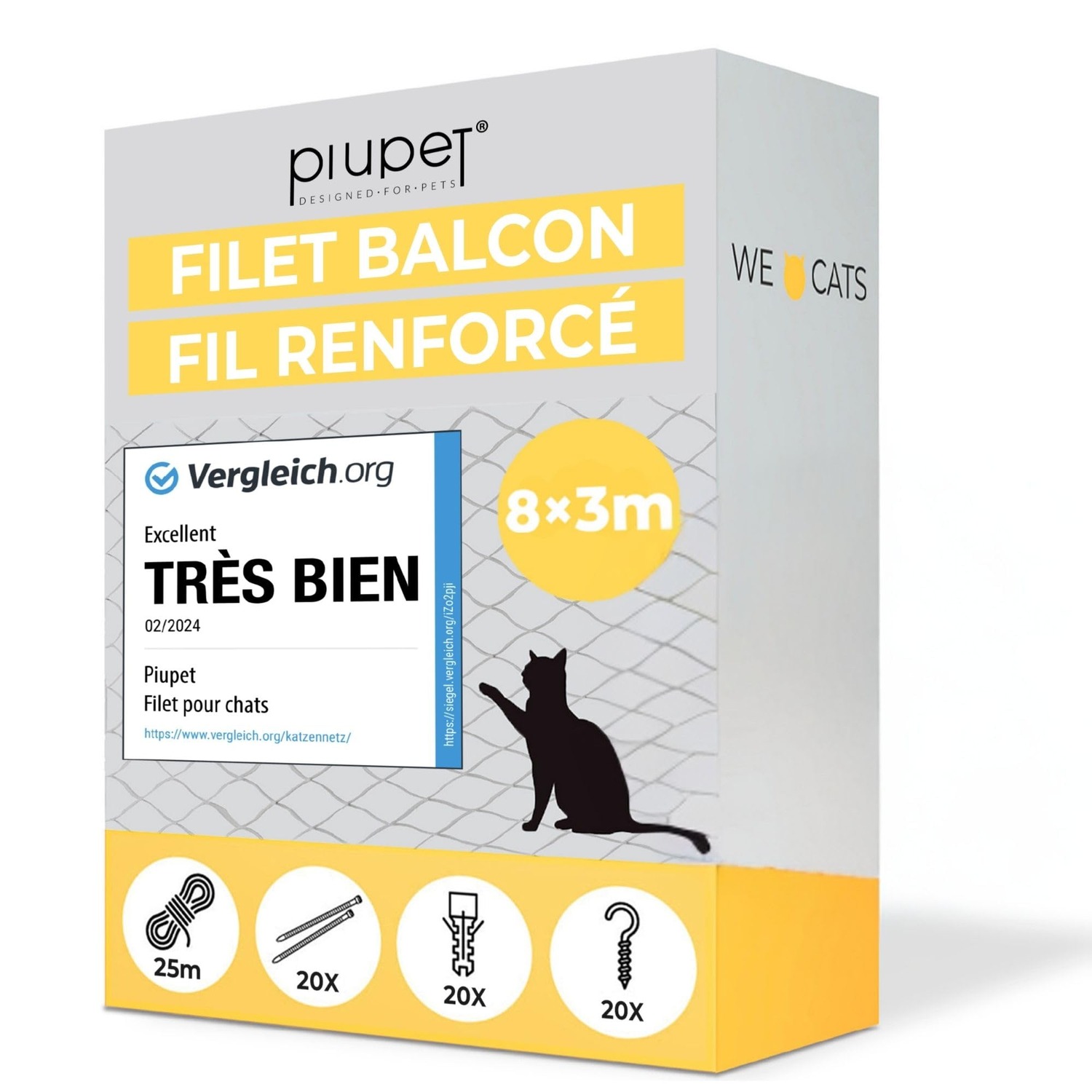
The fixing kit is included rather than sold separately. You get 25 metres of fixing rope, 15 cable ties, 20 hooks, 20 dowels and an instruction sheet. For a simple rectangular balcony that may be enough. If your space has pillars, a pergola, air conditioning units or a sloped roof edge, buy an extra bag of cable ties before you start. They cost very little and running short halfway through is frustrating.
Who this suits
Apartment dwellers with a railing balcony are the obvious group. So are people in upper floor flats who want to open a window in summer without a cat flap arrangement.
Renters do well with this product because it can be fitted without drilling. Rope threaded through the mesh edge, then cable tied to the railing at close intervals, can hold a balcony net for cats without drilling. Check your lease, take photos before and after, and keep the hooks and dowels in the box for a future home.
It also suits people building their own enclosure. If you are framing a cat enclosure netting project in timber or aluminium, this panel can be the skin.
It is less suitable if your main concern is small birds or insects. The 3cm mesh will not stop either. It is sold as a cat net.
How to choose and measure
Start by measuring the opening you want to close, including height. People remember the width and forget that a railing is only a metre high while the gap above it might be two metres more. If you are netting from railing to ceiling, your height measurement is the one that decides how much of the 3 metre width you need.
Next, look for the gaps a cat will find. Cats do not use the obvious route. They use the 15 centimetre space beside the air conditioning bracket, or the slot where the net stops short of a downpipe. Walk the whole perimeter and note every point where the mesh will meet something other than a straight edge.
Then plan your anchor points. Aim for a fixing every 25 to 40 centimetres along every edge. That sounds like a lot of ties. It is, and it makes a big difference to the fit.
Finally, think about tension. The net should be firm enough that pushing it with a flat palm gives a small amount of flex and springs back. If it swings loose, add fixings and pull it tighter.
Fitting it well
Thread the rope through the outer row of mesh along each edge first. This spreads the load along the whole edge instead of concentrating it on individual strands. Then tie the rope off at your anchor points and use cable ties between them.
Work from the top down. Secure the top edge fully, then the sides, then the bottom. Doing the bottom last lets you pull out the slack.
If you need to cut the net, use strong snips because of the wire. Bind the new edge immediately with rope or ties so the strands cannot unravel and no sharp ends sit where a cat can reach.
Trim cable tie tails flush. A cat will chew a loose tail, and that is a habit you do not want to start.
Care and ongoing checks
Outdoor netting does not need much maintenance, but it does need attention. Rinse it with a hose a couple of times a year, or wipe it with a damp cloth. Let it dry naturally. Keep bleach, solvents and pressure washers away, since all three can damage plastic mesh.
Check the fixings every few weeks and always after a storm. You are looking for ties that have slipped, sections that have started to sag, and frays near the anchor points. Fixing one loose tie takes two minutes. Fixing a gap after a cat has found it takes considerably longer.
Every few months, look at the mesh itself. If any area has gone chalky, stiff or discoloured, that section has had enough sun and should be replaced.
The short version
This cat safety net is an 8 by 3 metre black polyethylene panel with wire woven through the strands, a 3cm mesh that keeps the view open, and a fixing kit of rope, cable ties, hooks and dowels in the box. It weighs 2kg and it can be fitted without drilling if you need to keep a landlord happy.
Measure carefully, fix often, pull it tight, and check it after windy weather. Keep an eye on your cat on the balcony too.